Integrate Your AI Agent with Zoho CRM | Kipps.AI
Easily connect your AI agent with any CRM to log conversations, automate follow-ups, and improve sales workflows using Kipps.AI.

How to Integrate Your AI Agent with a Zoho CRM
Introduction
CRM systems are the backbone of sales and support operations — they're where lead data, conversation history, and follow-up tasks are supposed to live. The problem is that AI agent conversations often happen somewhere else entirely: a chat widget, a WhatsApp thread, a phone call. Without an integration, every one of those conversations has to be manually copied into the CRM, or — more often — simply never makes it there at all.
By connecting your Kipps.AI agent to Zoho CRM, every interaction your agent has is automatically logged, tracked, and available to your sales or support team the moment it happens. This guide walks through connecting Kipps.AI to Zoho CRM end-to-end, including the Zoho-side steps of registering an OAuth application, which trips up more people than the Kipps.AI side does.
This is for teams already using Zoho CRM who want their AI agent's conversations to flow directly into it, rather than living only inside Kipps.AI's own dashboard.
Before You Start: Prerequisites
CRM integrations touch two systems, so plan for both sides:
- A Kipps.AI account with an agent already built and tested — chatbot, voice, or WhatsApp.
- An active Zoho CRM account, along with admin-level access (or a colleague who has it) since registering an OAuth application in the Zoho API Console typically requires administrative permissions.
- Clarity on your Zoho data center. Zoho operates region-specific data centers (for example, separate ones for different geographies), and your account's data center needs to match what you select during setup — using the wrong one is a common source of connection failures.
- A decision on what data you want synced. Before you connect anything, decide what a conversation should create or update in Zoho — a new lead, a note on an existing contact, a task for a sales rep — since this shapes how you'll want to configure your agent's conversation flow to capture that information cleanly.
How to Get Started
The setup has two halves: registering an application inside Zoho's API Console to get credentials, and then entering those credentials into Kipps.AI. Do them in order — you'll need the Zoho credentials before the Kipps.AI side can be completed.
Step 1: Log in or sign up
Log in to your Kipps.AI account, or create one if you're just getting started.
Step 2: Create your chatbot
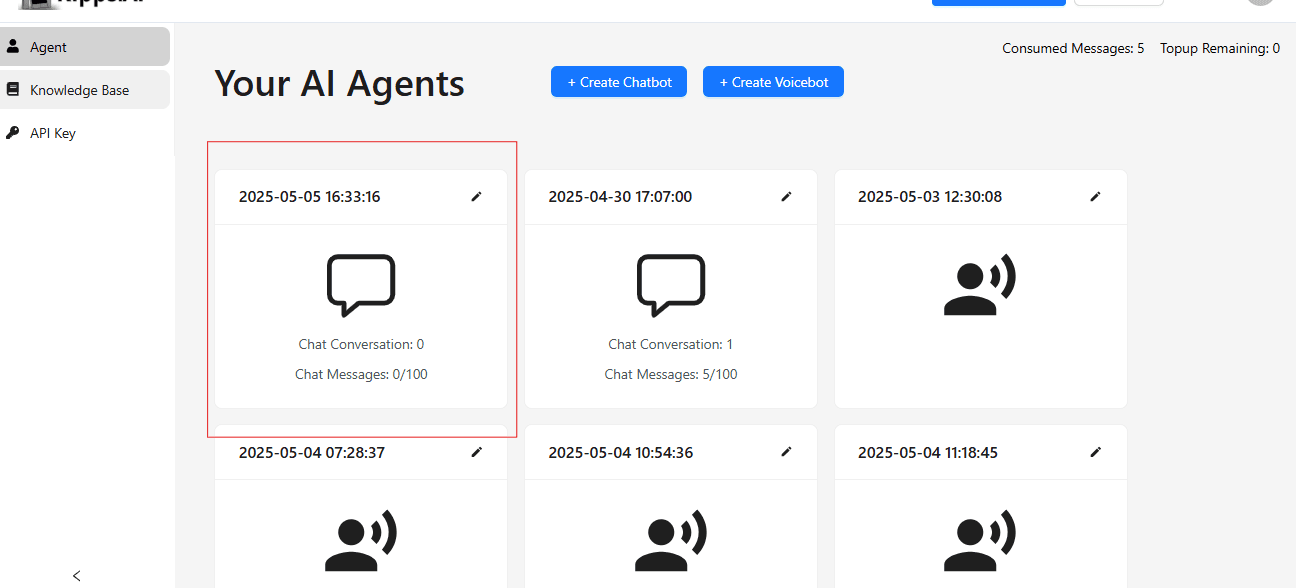
Create and configure your chatbot — its persona, knowledge base, and conversation flow — before wiring it to the CRM. It's worth having the agent's conversation logic settled first, since that determines what data will actually be available to send to Zoho.
Step 3: Open the Integration section
From your chatbot's dashboard, click on the Integration section.
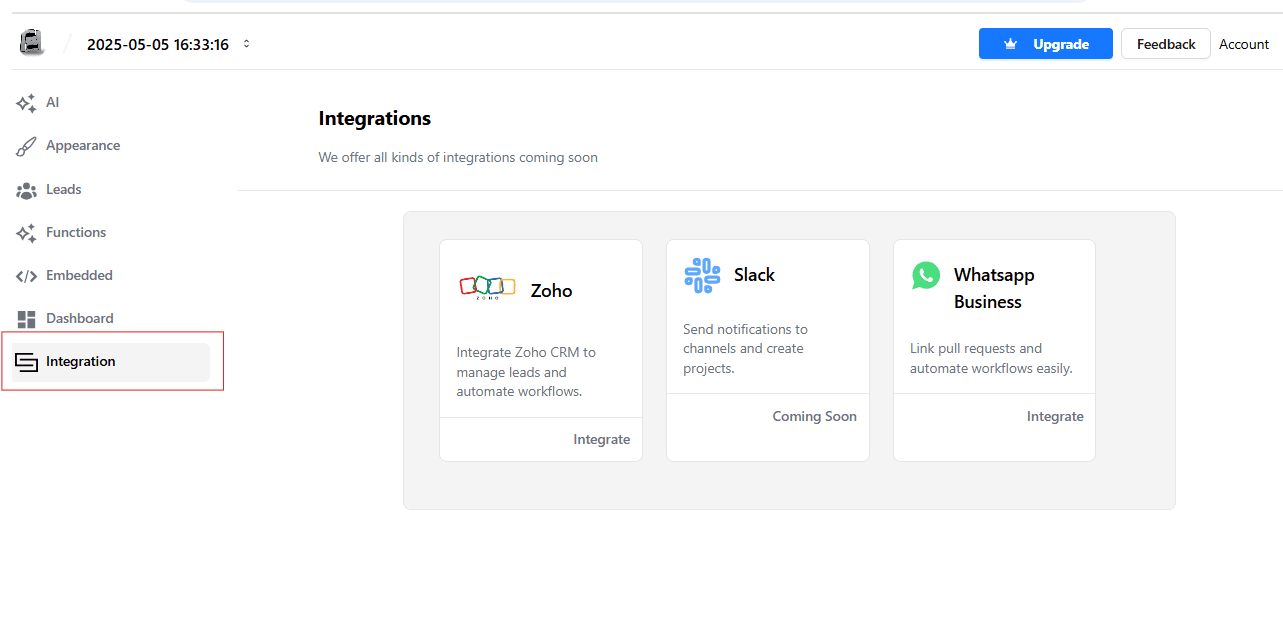
Step 4: Choose Zoho CRM
Select Zoho CRM from the list of available integrations and click through to begin the connection.
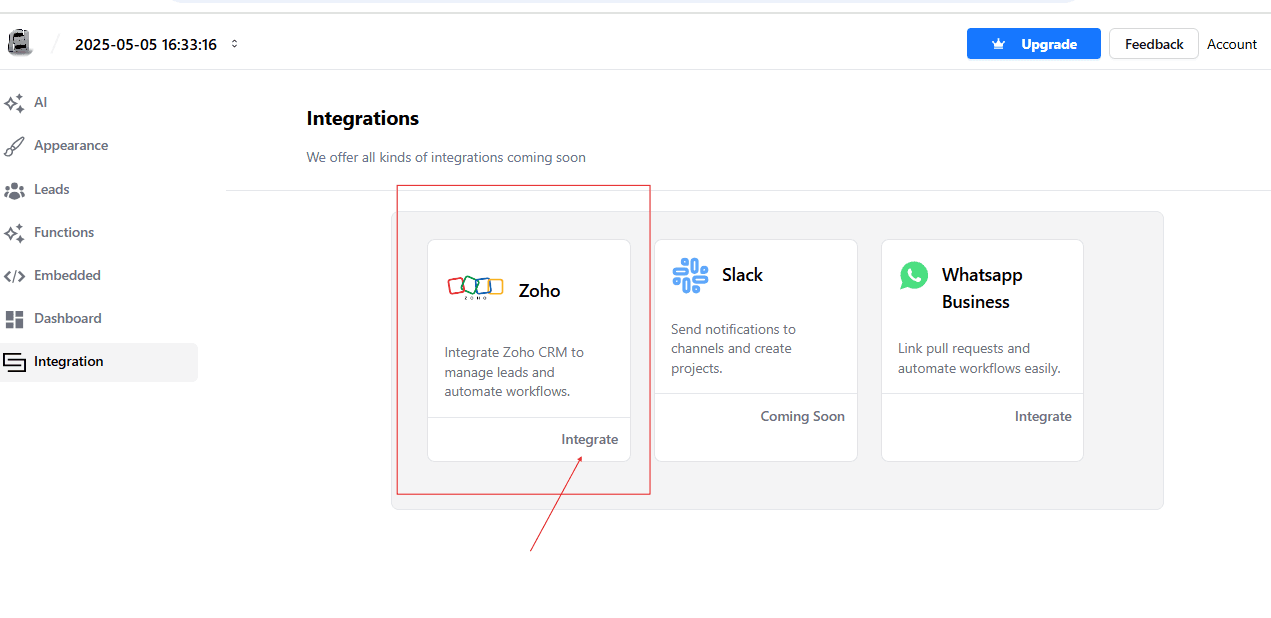
Step 5: Copy the redirect link
Copy the link Kipps.AI provides. You'll need this in a moment when registering your application in Zoho's API Console, as the Authorized Redirect URI.
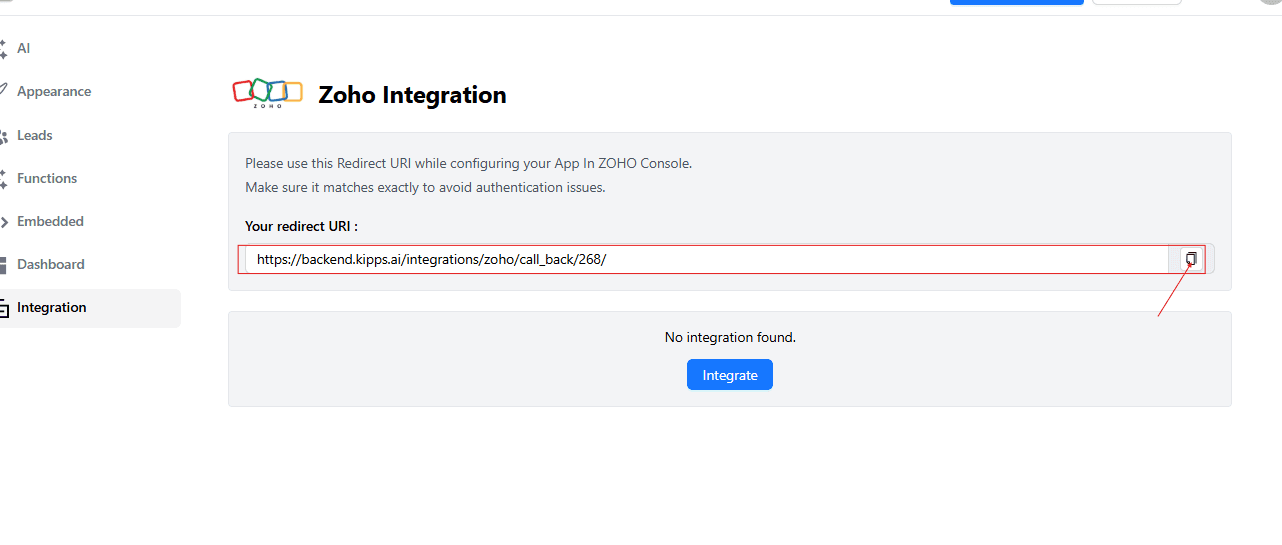
Step 6: Register an application in the Zoho API Console
Go to the Zoho API Console, sign in (or create a Zoho account if you don't have one), and click Get Started.
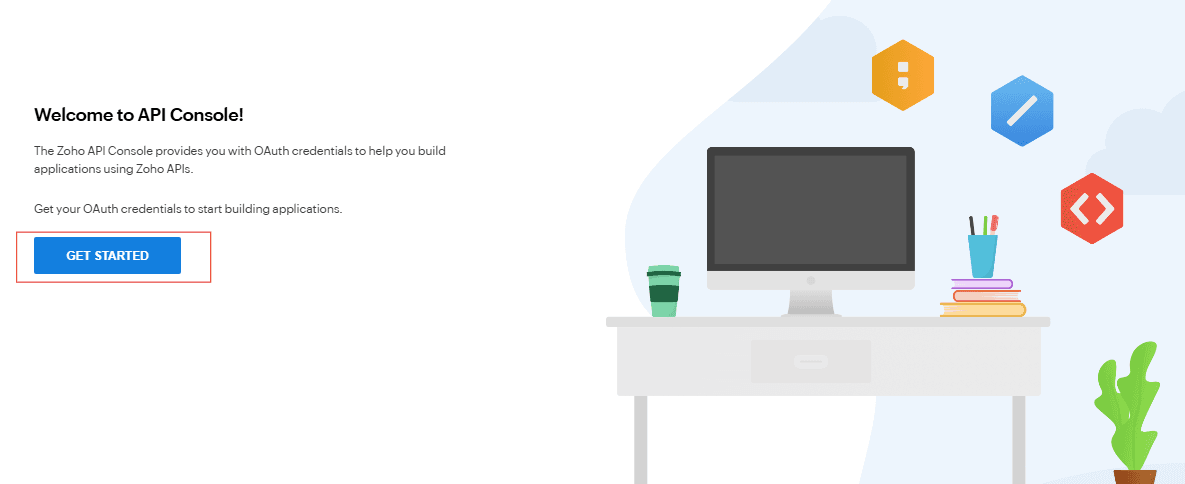
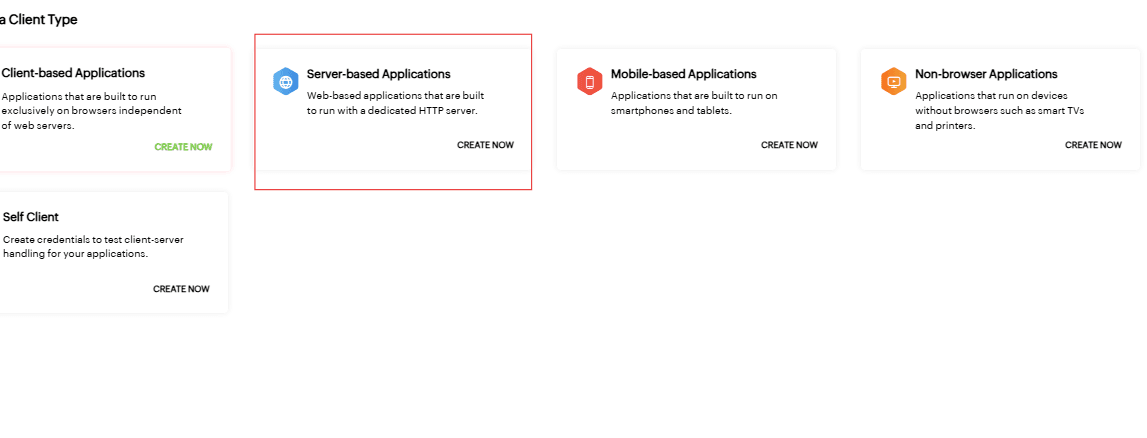
Step 7: Create a server-based application
Choose Server-based Application as the application type and click Create. This application type is what generates the OAuth client credentials Kipps.AI needs to authenticate on your behalf.
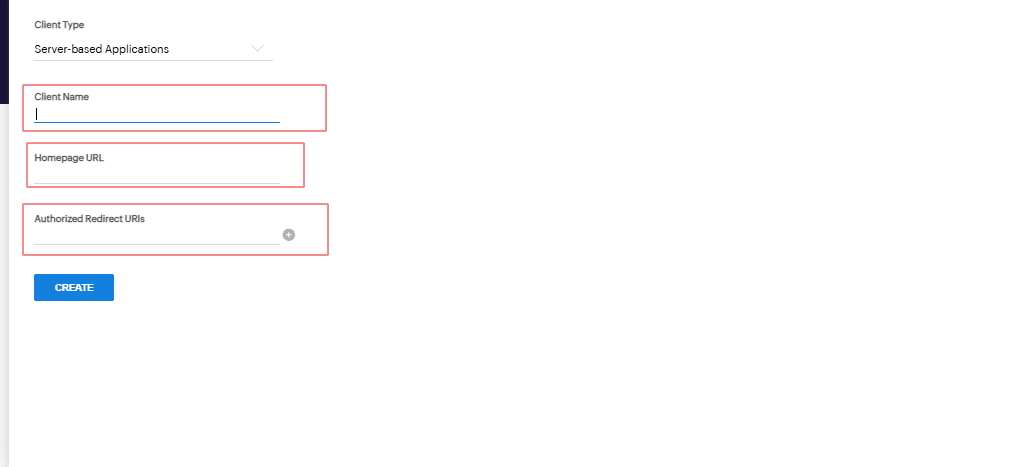
Step 8: Fill in the application details
Enter a Client Name, your Homepage URL, and the Authorized Redirect URI — paste the link you copied from Kipps.AI in Step 5 here. This redirect URI is what tells Zoho where to send authentication responses, so it needs to match exactly.
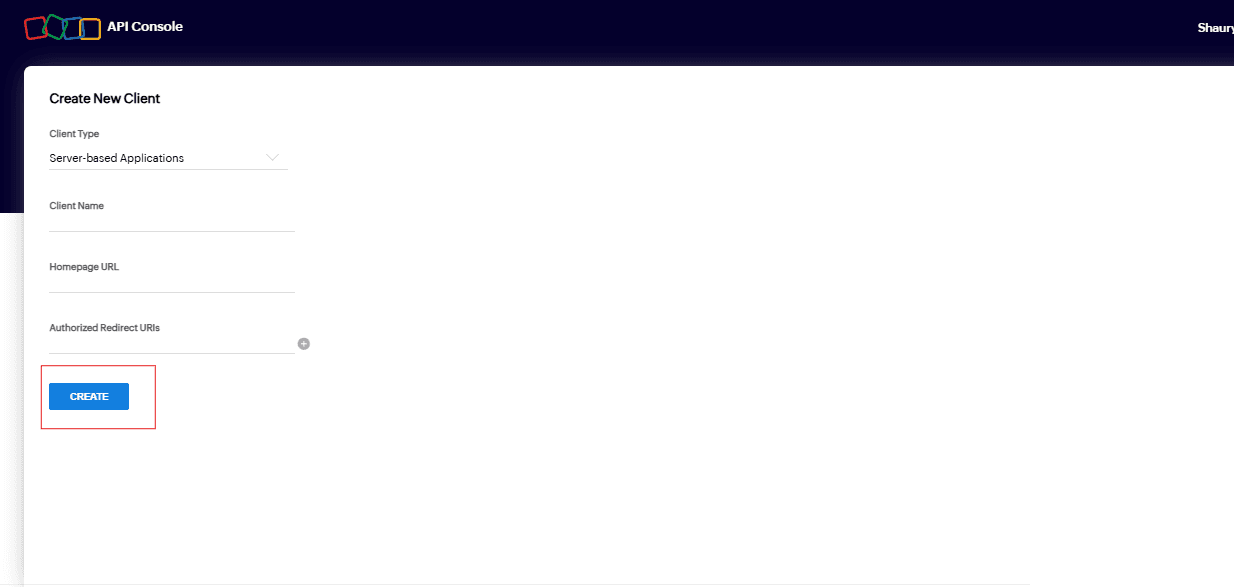
Step 9: Create the application
Click Create to finish registering the application in Zoho.
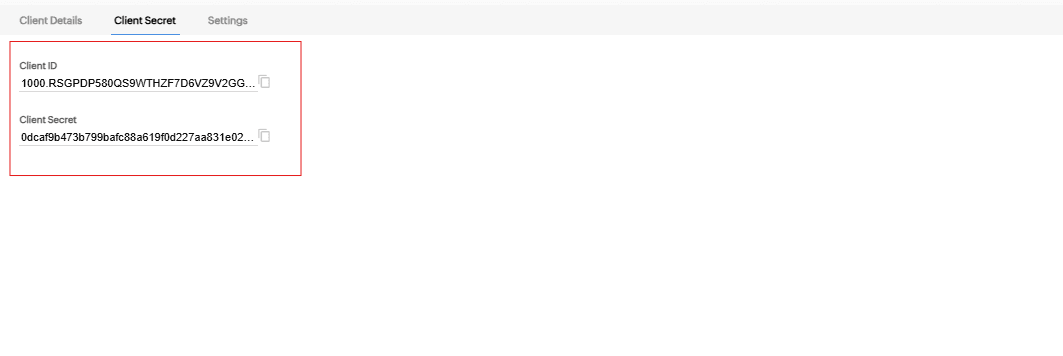
Step 10: Copy your Client ID and Client Secret
Zoho now generates your ZOHO_CLIENT_ID and ZOHO_CLIENT_SECRET. Copy both — you'll enter them into Kipps.AI next. Treat the client secret with the same care as a password: store it securely and avoid sharing it outside the people setting up this integration.
Step 11: Return to Kipps.AI and click Integrate
Back in Kipps.AI, click the Integrate button to continue the connection.
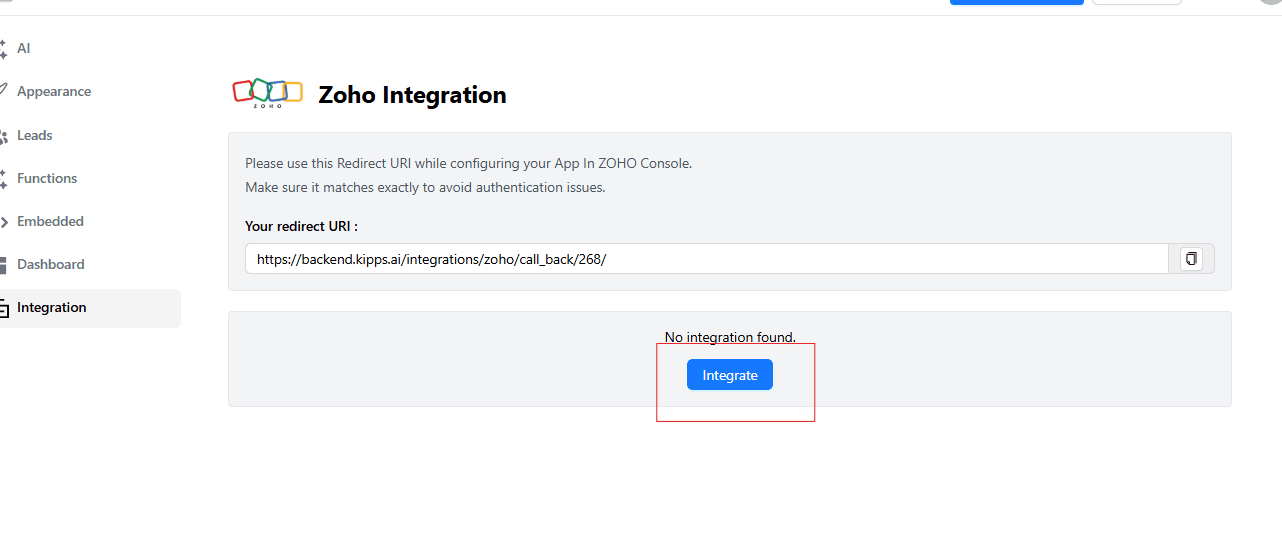
Step 12: Enter your Zoho credentials
Fill in the required fields:
- ZOHO_CLIENT_ID
- ZOHO_CLIENT_SECRET
- Email (the Zoho account email tied to your CRM)
- Data Center (DC) — select the region matching your Zoho account
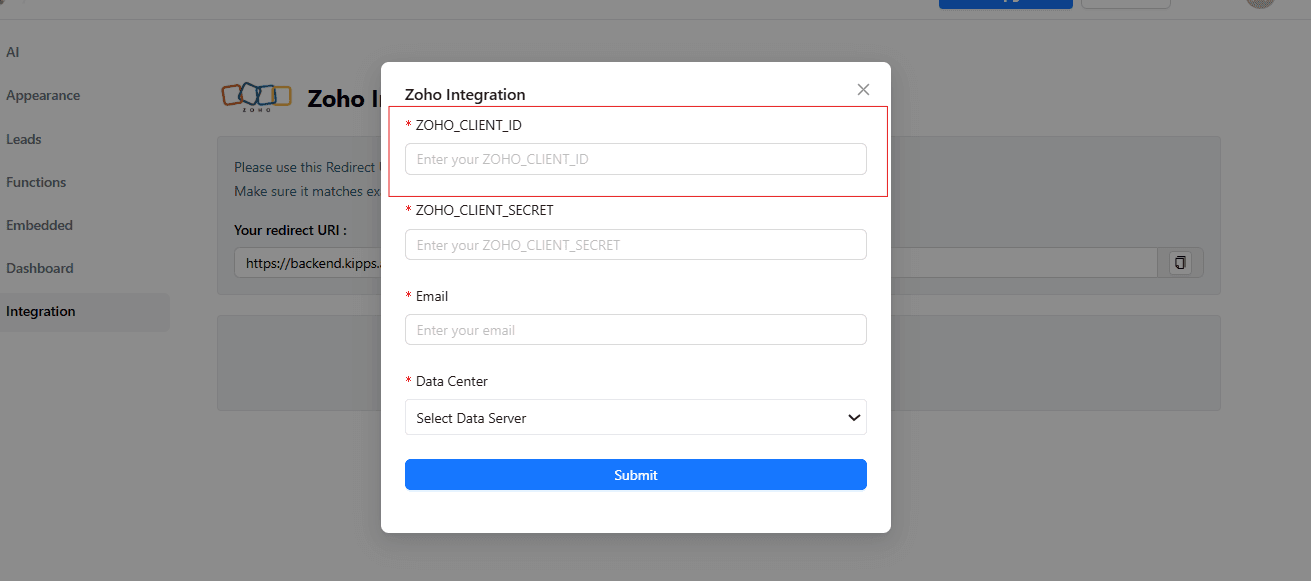
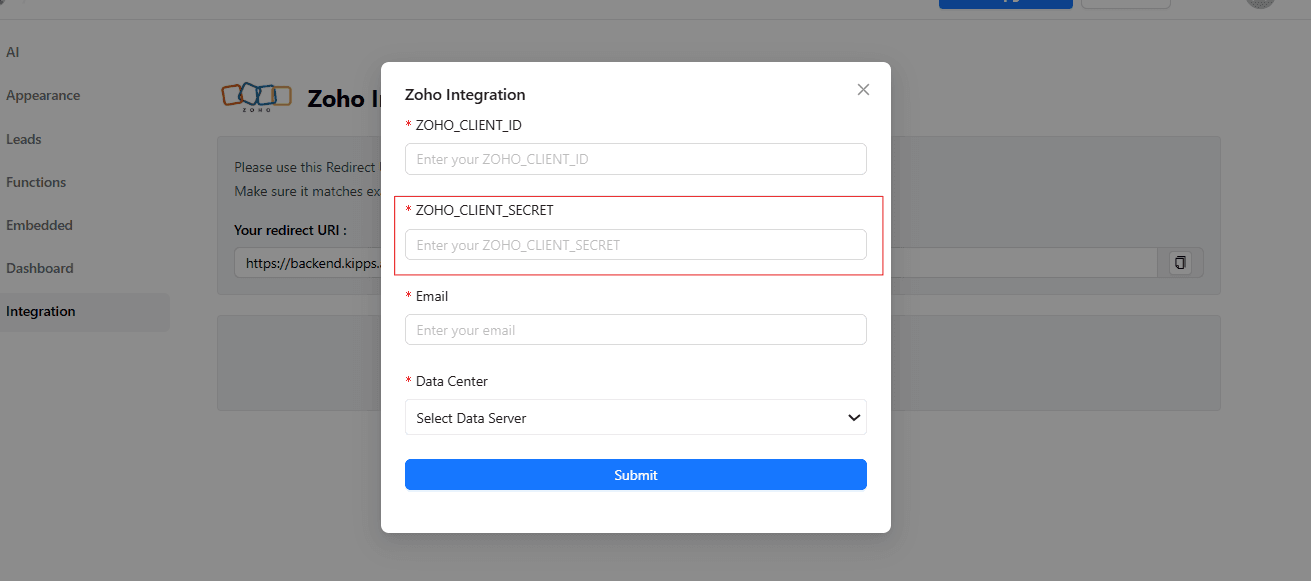
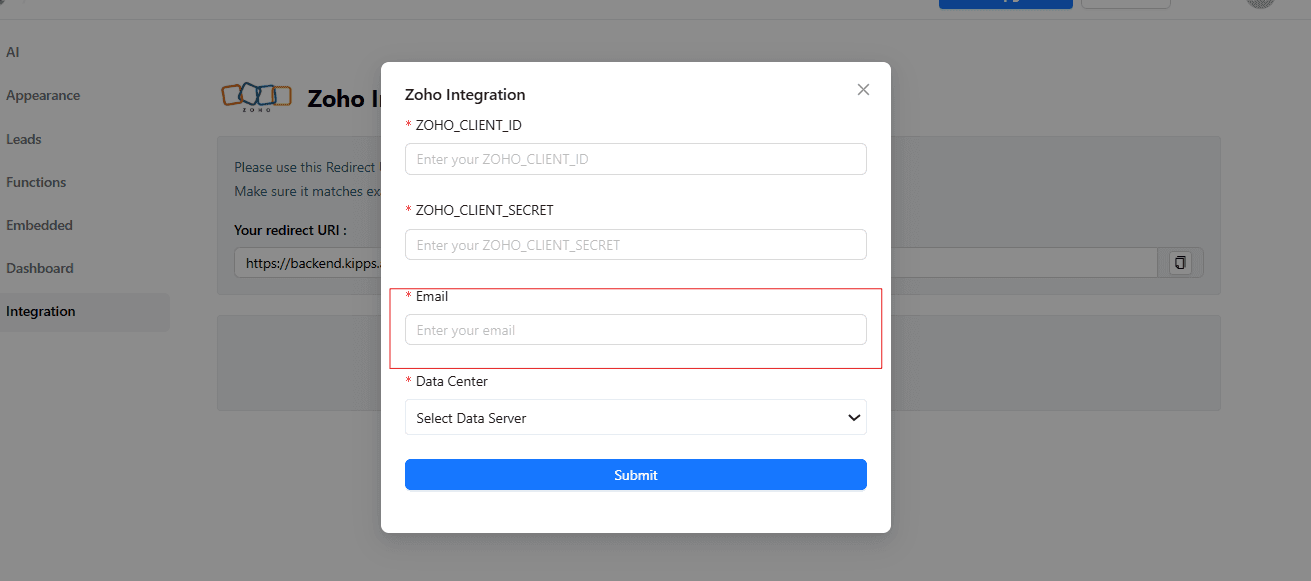
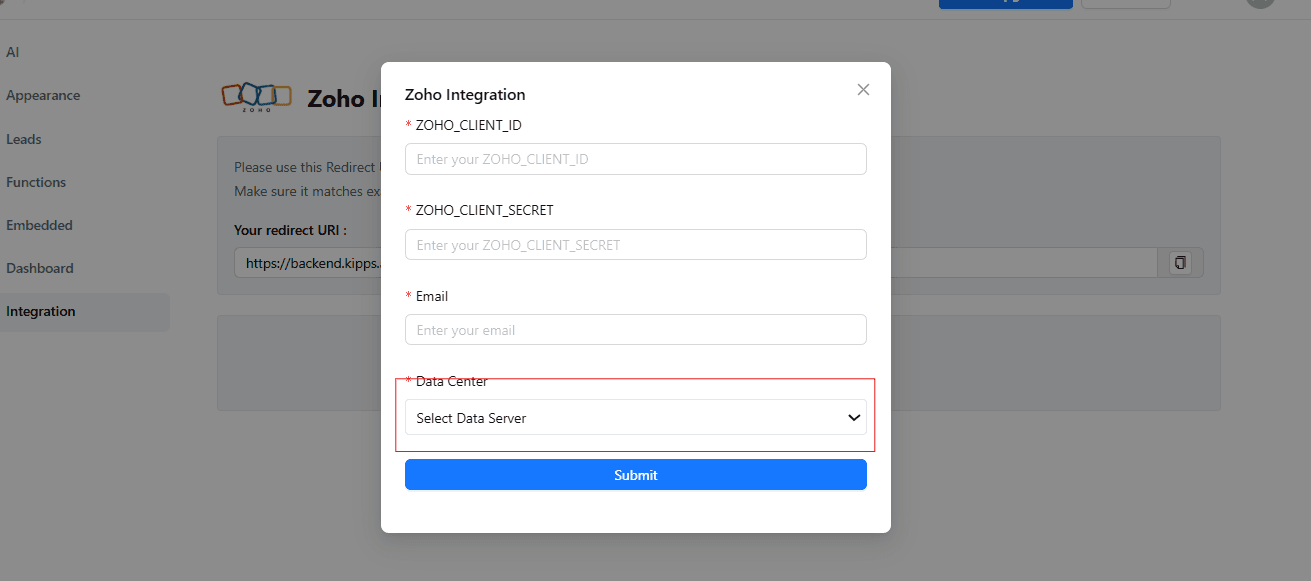
Getting the data center right matters more than it looks — Zoho routes API calls to region-specific servers, and selecting the wrong one is one of the most common reasons this integration fails to authenticate even when every other field is correct.
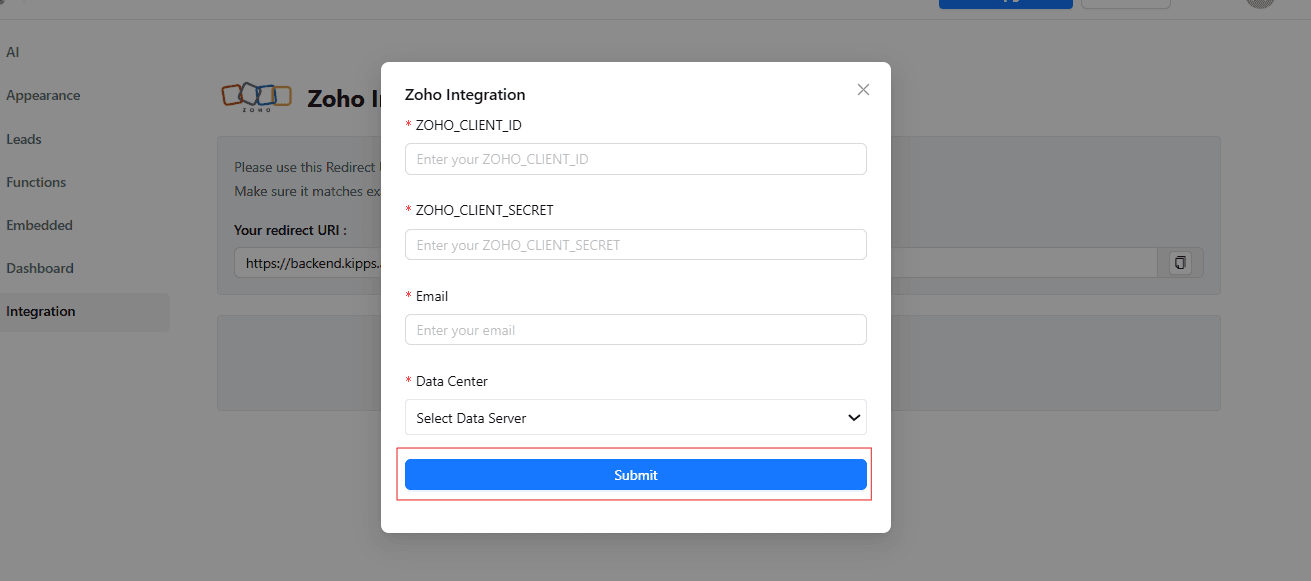
Step 13: Submit and activate
Click Submit to activate your Zoho CRM integration. Once it's live, run a test conversation through your agent and confirm the resulting lead or contact record actually appears in Zoho with the fields you expect.
Troubleshooting
The integration fails to authenticate even though my Client ID and Secret look correct. Double-check the Data Center selection first — this is the single most common cause of authentication failures in this integration, since a Zoho account registered in one region won't authenticate against another.
The Authorized Redirect URI doesn't match, and Zoho rejects the connection. Make sure the URI you pasted into the Zoho API Console in Step 8 is exactly the link Kipps.AI gave you in Step 5, with no missing characters or extra whitespace — Zoho matches this value exactly.
Conversations aren't showing up as leads or contacts in Zoho. Confirm the integration status shows as active in Kipps.AI, and check whether your agent's conversation flow is actually capturing the information (name, email, phone) that would be needed to create a Zoho record — an agent that never asks for contact details has nothing to sync.
I'm getting permission errors from Zoho. Confirm the Zoho account used to register the application and authorize the integration has sufficient permissions in your CRM — some organizations restrict API access to admin-level users only.
The integration worked initially but has since stopped syncing. OAuth connections can expire or be revoked on the Zoho side (for example, if a password changes or an admin revokes API access). Reconnect the integration in Kipps.AI to refresh the authorization.
Best Practices
- Decide what counts as a "lead" before you launch, not after. Agree with your sales team on what conversation signals should create a new CRM record versus just logging as a note on an existing one.
- Keep a dedicated Zoho user or API profile for the integration rather than tying it to a single employee's personal login — if that person leaves or changes their password, the integration can break unexpectedly.
- Regularly audit what's landing in Zoho. In the first few weeks, spot-check that conversations are creating clean, correctly-mapped records rather than duplicates or incomplete entries.
- Align your agent's questions with your CRM's required fields. If Zoho expects a phone number and industry for a qualified lead, make sure your agent's conversation flow is actually collecting both.
- Document the setup, especially the Zoho-side Client ID, Secret, and Data Center, somewhere your team can find it later — this integration is set up rarely enough that details are easy to forget by the time it needs troubleshooting.
Use Cases
- Automatically log AI chats or calls in your CRM
- Trigger CRM workflows based on user responses
- Personalize messages using customer data
Frequently Asked Questions
You'll typically need sufficient permissions to register an application in the Zoho API Console and authorize API access, which in many organizations means admin-level access. If you're not an admin, loop in whoever manages your Zoho account before starting.
Selecting the wrong Zoho Data Center during setup. Zoho routes requests to region-specific servers, so the DC selected in Kipps.AI must match where your Zoho account actually lives.
That depends on how your agent's conversation flow is designed and what data it captures. The integration syncs data to Zoho, but your agent still needs to be configured to collect the information (like name and contact details) that a CRM record requires.
Each integration connects a given Kipps.AI agent to a specific Zoho account and data center. If you run multiple agents that need to feed different CRM instances, each one is configured with its own integration.
The integration syncs conversations going forward from when it's activated; it isn't a retroactive import of historical chat data into Zoho.
Kipps.AI allows seamless CRM integration, enabling smarter automation and aligned customer experiences across every touchpoint. It improves visibility, speeds up workflows, and enables more personalized, data-driven communication — eliminating the silo between customer conversations and the backend processes that turn them into revenue.
Ready to connect your agent to Zoho CRM? Talk to our team or explore the platform at kipps.ai.